Location search: By proximity? Or in a specific location?
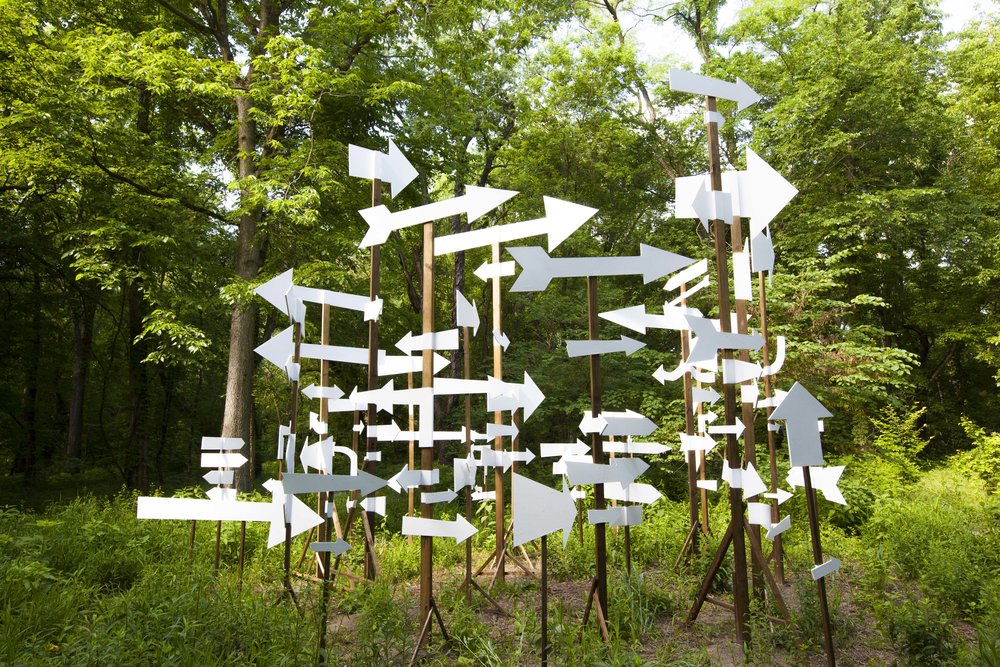
One exciting new feature of ACMP’s online directories is our “dual location search”
It’s exciting to me – but maybe confusing to some of you as well! Like the art installation by Kim Beck, pictured above, a version of which I experienced at Art Omi in Ghent, New York when I was a Music Fellow there. Where to start and which way to go?
(Fun fact: I got lost so badly in “The Fields” sculpture park at Art Omi that I had to call their Welcome Center and get rescued by a man in a golf cart.)
Anyway, I digress…
Dual location search gives you the best of both worlds – the convenience of proximity search (which was already a feature on our old website) and the ability to see who is exactly where – just like in the old printed directory.
It’s not nearly as complicated as Kim Beck’s installation! It’s just a question of noticing the toggle to switch between “By proximity” and “In a specific location” and knowing which kind of search works best in which situations.
In all of our online directories, that toggle appears under the title on the left side: it says “Search” and there are 2 options with little circles next to them, which you can click to select. The default setting is what most people will use most of the time – “By proximity.” When “By proximity” is selected, the box to the right of where you type in a place name says “Within” and allows you to set the distance. The default setting is 50 miles (in all directions) from the location you enter. You can click the arrow for a dropdown menu allowing you to search as close as 5 miles away or as far away as 500.
When to use Specific Location Search
In designing this new site, David Choy and I were extremely aware that it was impossible to search for players by country in the old website. That was not a problem unique to ACMP. Our directory, like about 99% of similar online directories, was using a PROXIMITY or “geolocation” search – searching for options that were within a certain distance from the location entered by the user. In the case of entire countries, or even states in a large country like the US – it searches within a specified distance from the middle of that area.
A good example from the ACMP Directory of Chamber Musicians is Germany. In the screen shot below, I was searching for ACMP members in Germany with the default location search of “by proximity” selected.
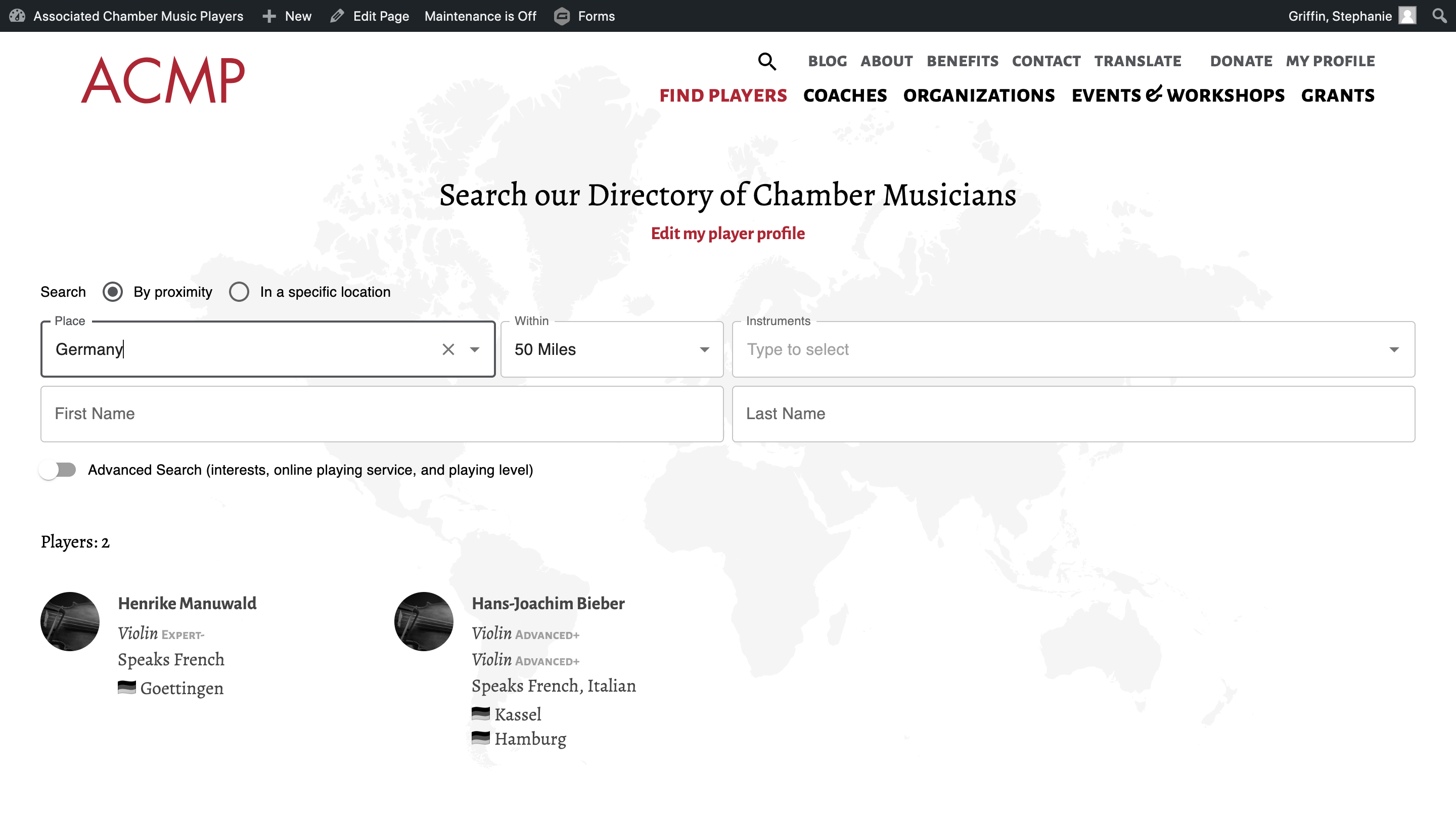
Only two players! In all of Germany?
Fear not! This only means that we have only 2 ACMP members within 50 miles of the exact middle of Germany.
(Chamber players from the middle of Germany, please Join ACMP. Membership is free.)
Trying again – I selected “In a specific location.”
There are actually 48 players in Germany. See the screen shot, below:
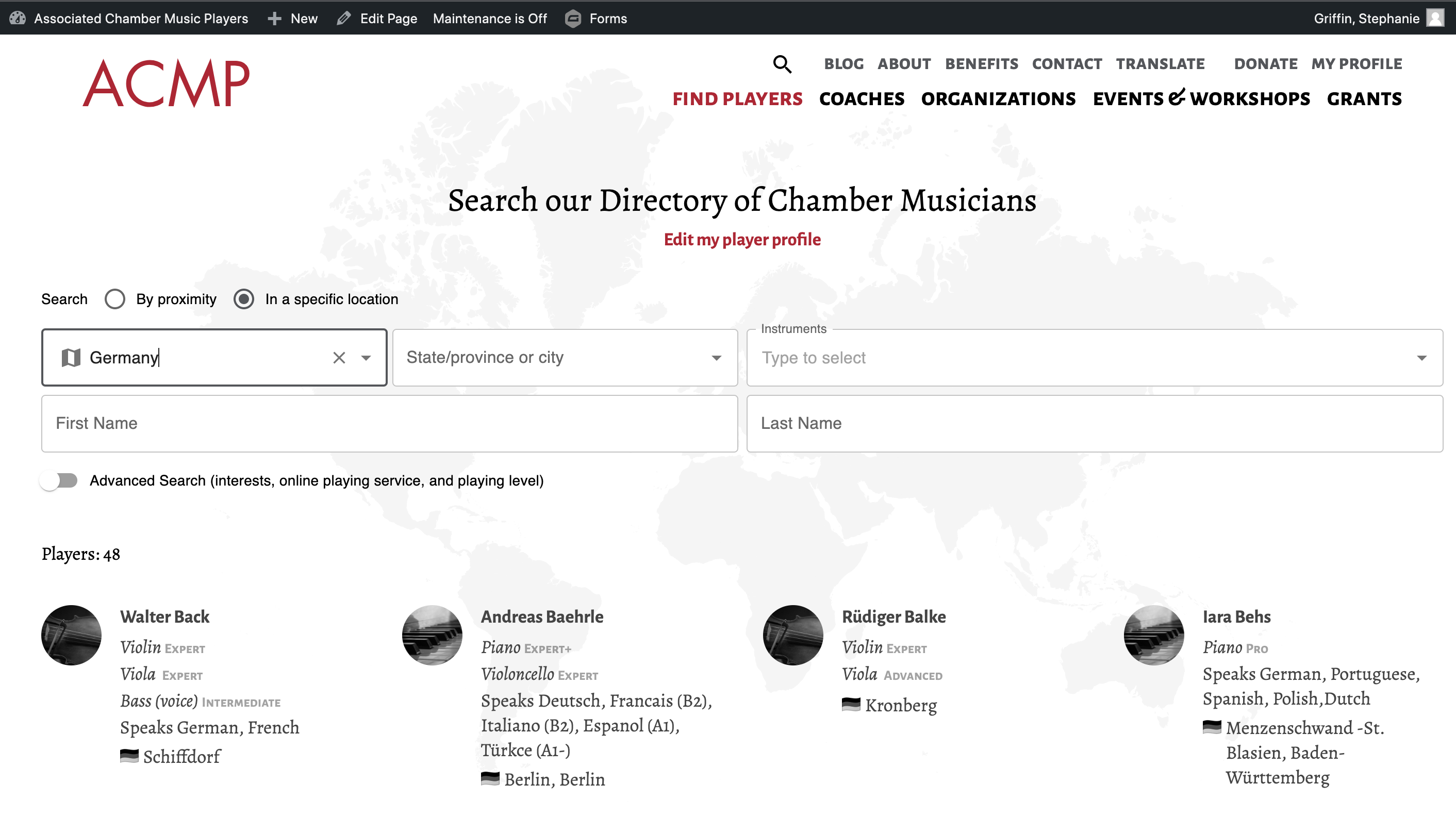
Let’s get more detailed in our search for players in Germany
When you use our “In a specific location” search tool, you always have to choose the country first, in the box on the far left. (That box says “Country” until you type in something and the dropdown list of countries where ACMP has members appears.) The box to the right of “Country” is labeled “State/province or city.” You can start typing in that box, and you will see all the options where ACMP currently has members in your chosen country. In this way, it really does mimic the paper directory, where ACMP members could leaf through pages of listings organized by country, state/province and city.
In the online directory, the dropdown “State/province or city” menu has states or provinces (Bundesland, in Germany) listed alphabetically in boldface type, with the cities within those areas listed alphabetically below each one, as in this screen shot:
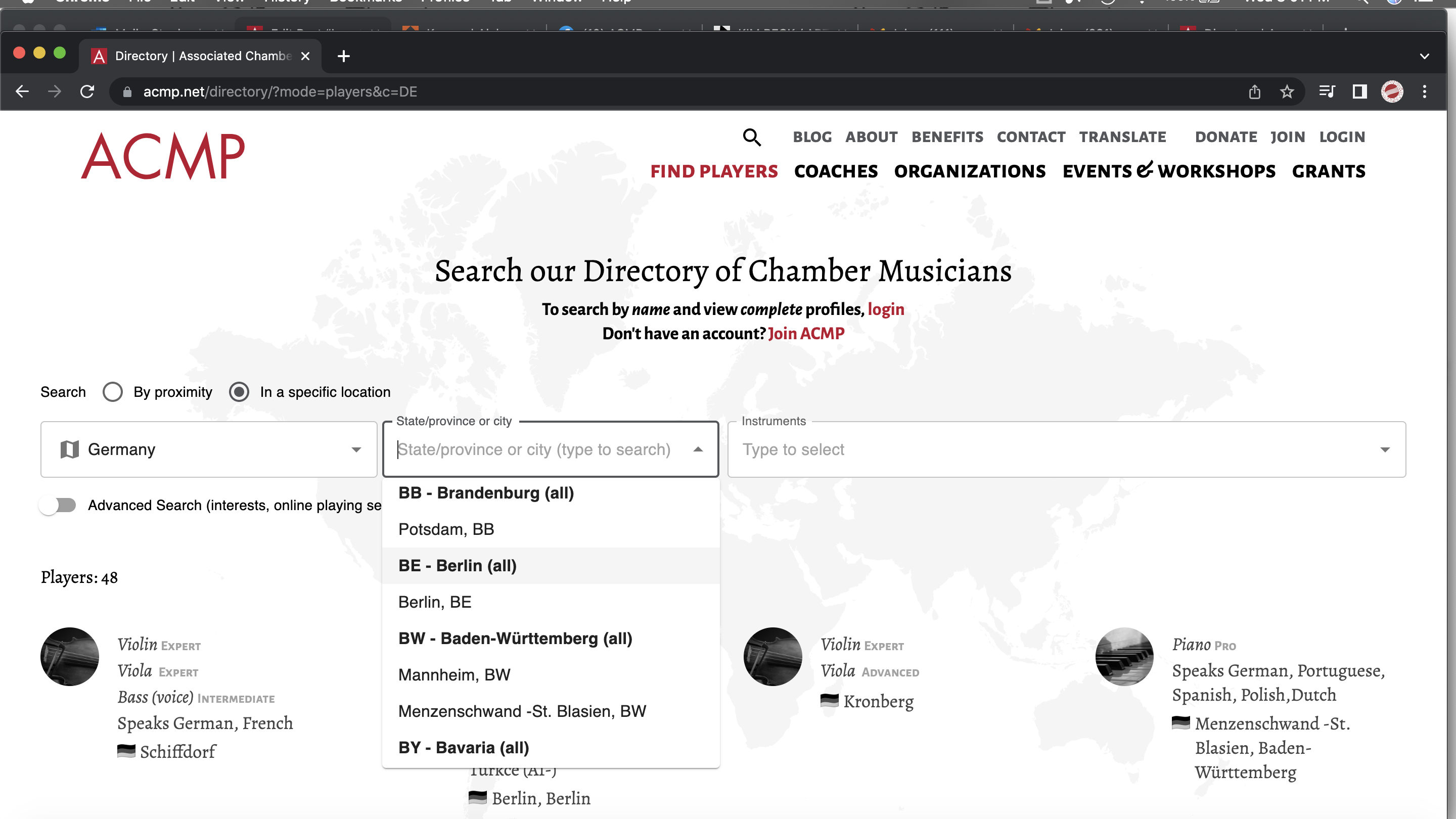
I am going to Berlin at the end of the month. So, I selected “Berlin, All” Let me see who is there…
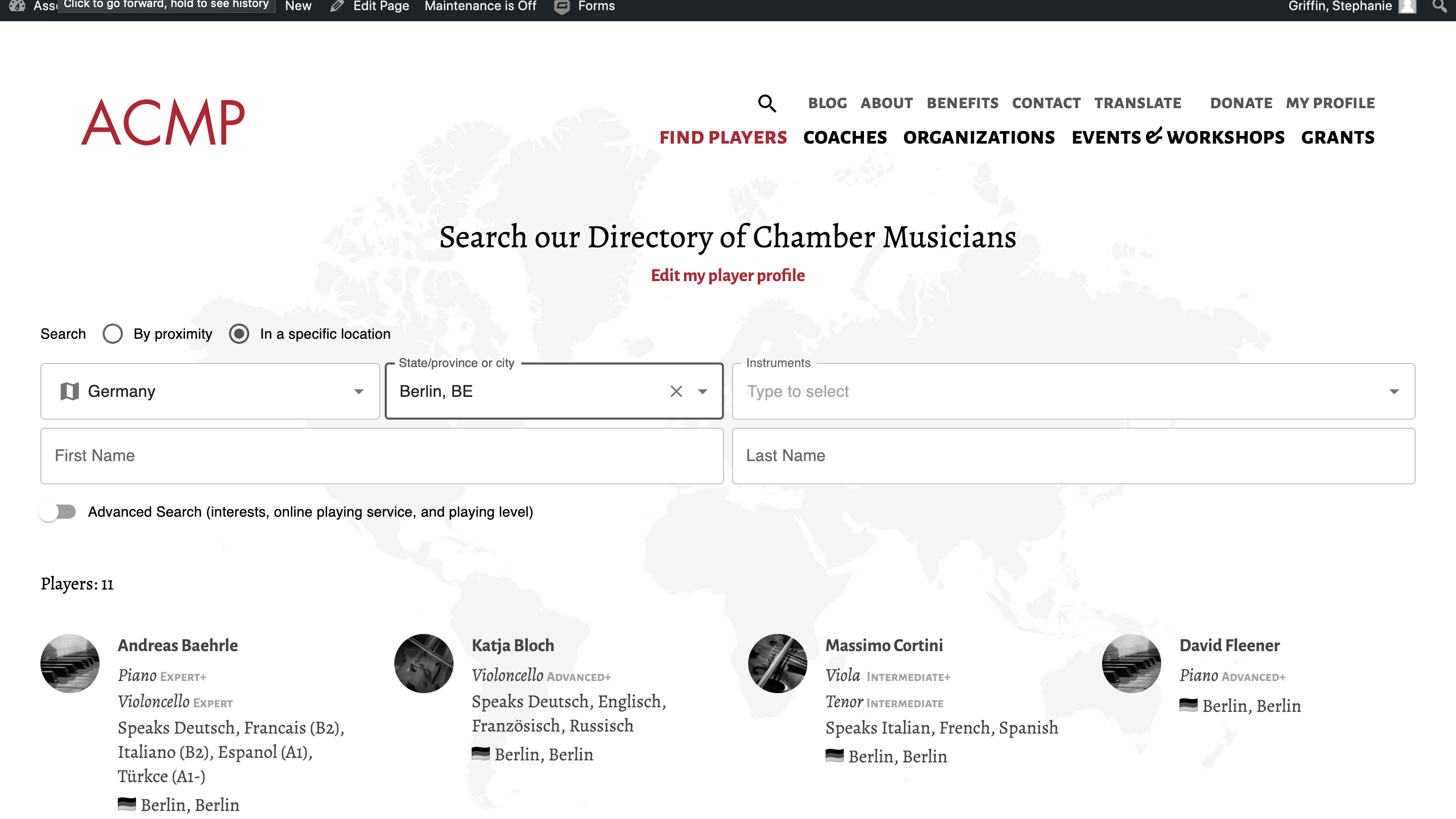
You get the idea! Try it yourself with other countries, or with states or provinces within Canada or the United States.
When to search by proximity
Unless you are planning a trip and want to know exactly who is in a whole country or a whole state or province, you are most likely looking for players, coaches and chamber music organizations near you.
Proximity search is especially important if you live in a small town or rural area and if you live in a large metropolitan area. It seems like a contradiction in terms that it would be the best way to search in both of those radically different contexts, but let me explain why:
If you live in a small town or rural area, there may not be any other ACMP members in your exact location. The “In a specific location” search will fail you in most cases. You are highly likely to find players in neighboring communities, however.
I just tried looking for players in Ghent, New York, where I saw Kim Beck’s whimsical art installation. The “In a specific location” search yielded one player living in Ghent itself. When I searched “By proximity” there were 58 players within 50 miles in all directions. 19 within 25 miles. 2 within 10.
Likewise, if you are looking for players in a large metropolitan area like New York City, where ACMP is based:
Searching in a specific location yields 154 players
Searching by proximity – there are 207 players within 10 miles
The big issue with big cities like New York is that there may be large numbers of players in what we call the outer boroughs – Brooklyn, the Bronx, Queens and Staten Island. “New York, NY” in a specific location search will only list players in Manhattan. And then there are players very nearby in New Jersey, Connecticut, Long Island.
It’s the same problem in Los Angeles, San Francisco, Chicago, Boston, Philadelphia, Detroit, Washington, DC – the list goes on.
We have fewer members internationally, but you will definitely want to use proximity search for London, in the UK, for example.
I hope this article helps you find who and what you need and that you meet many new players in your area and all around the world!
More Articles
How to Find Players and Build your ACMP Community
There is a time in every player’s musical life when you realize that you want to play more, but not quite sure with whom or where to even begin. Here are some ways to get started and begin building a community around you.Read More ↗
Member of the Month: Amit Rotem
By day, Amit Rotem works as a child psychiatrist specializing in youth addictions at the Centre for Addiction and Mental Health in Toronto. When he is not there, or with his family, there is a good chance he is playing his cello, with as many willing chamber partners as the calendar will allow!Read More ↗
2026 Worldwide Play-In Events
ACMP’s Official Worldwide Play-In Weekend takes place from Friday, May 15 through Sunday, May 17, 2026, but we are encouraging more play-ins throughout the month of May which is National Chamber Music Month in the United States. Keep checking this article for links to May play-ins!Read More ↗
Find Your Musical Community This Spring at 92NY
For many musicians, chamber music is as much about connection as it is about repertoire—the shared experience of listening, collaborating, and discovering new musical perspectives together. At the 92NY School of Music, two chamber music programs offer welcoming entry points into that experience this spring: Chamber Music Reading and Chamber Music Coaching & Performance. Whether you’re picking up your instrument again, looking to meet fellow players, or hoping to deepen your ensemble work, both programs are designed to bring musicians together in a supportive and engaging environment.Read More ↗
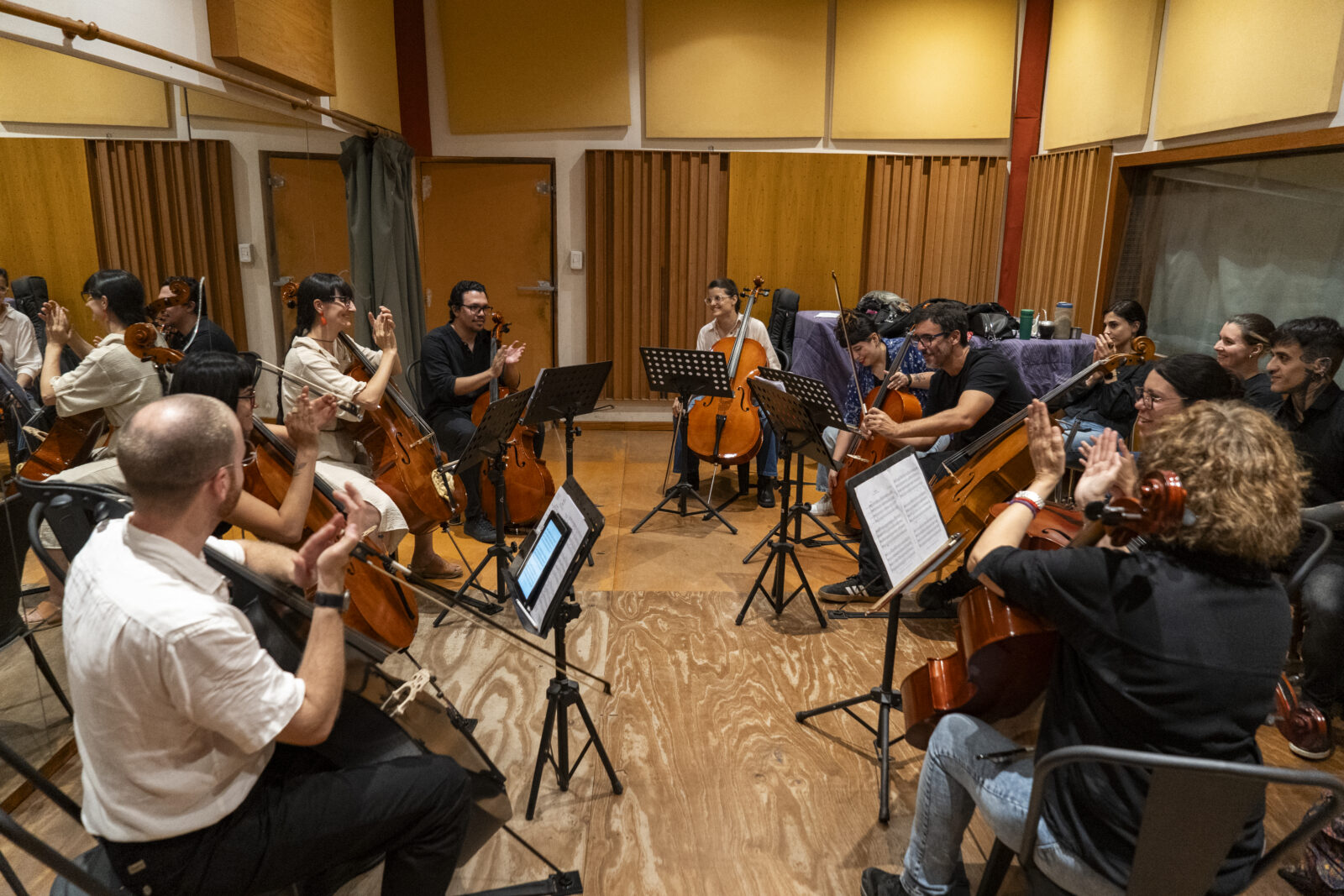
ACMP’s debut in Argentina: a cello gathering in Buenos Aires
Cellist Andrew Brush organized ACMP's first event in Argentina: an all-cello play-in, guided by Chilean professional cellist Denisse Almonacid in Buenos Aires.Read More ↗
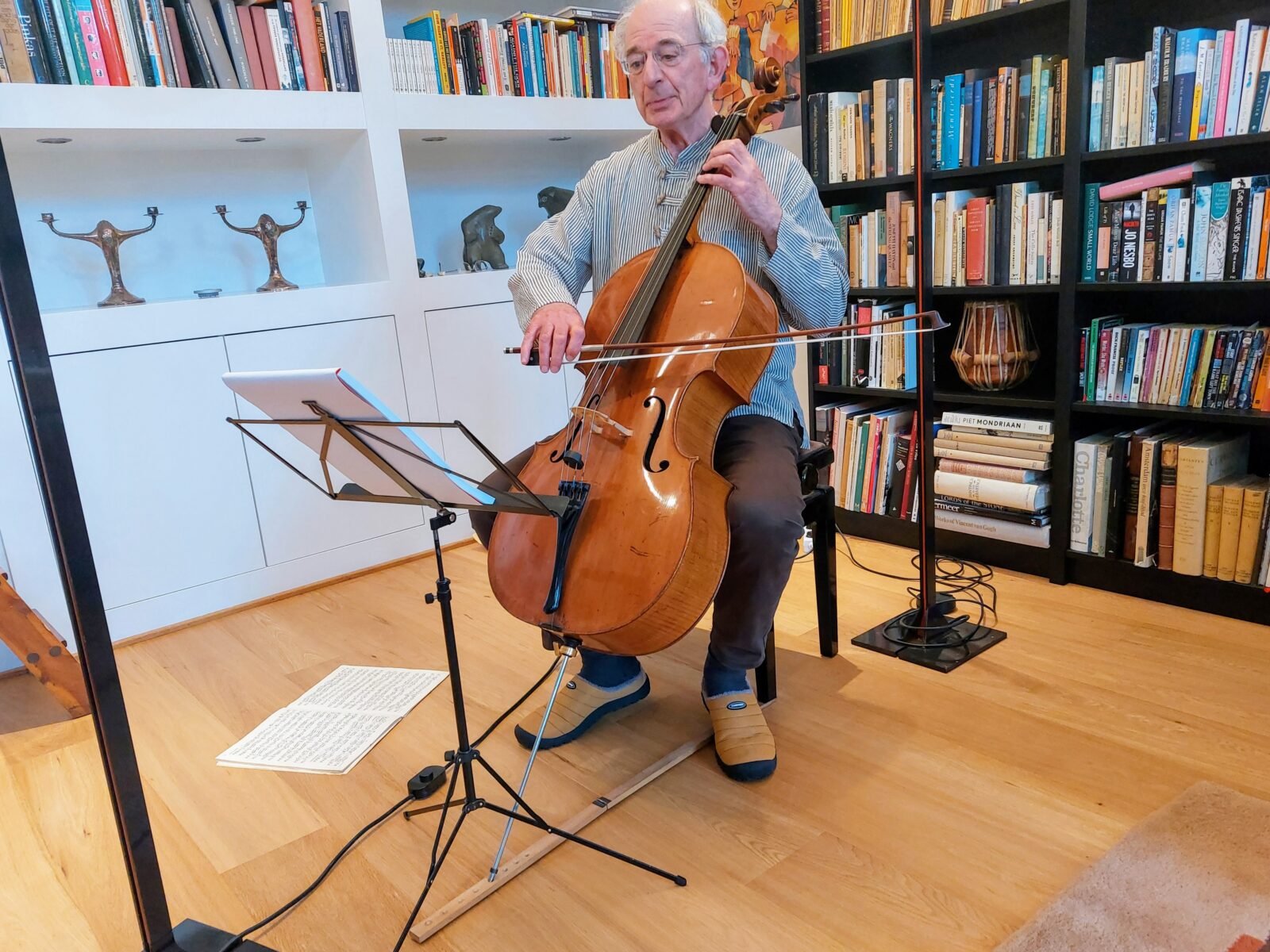
Jan Magnus, cellist – Retirement can wait. Chamber music can’t
At 76, Jan Magnus is still teaching in Amsterdam and making chamber music wherever he goes, with no plans of slowing down.Read More ↗
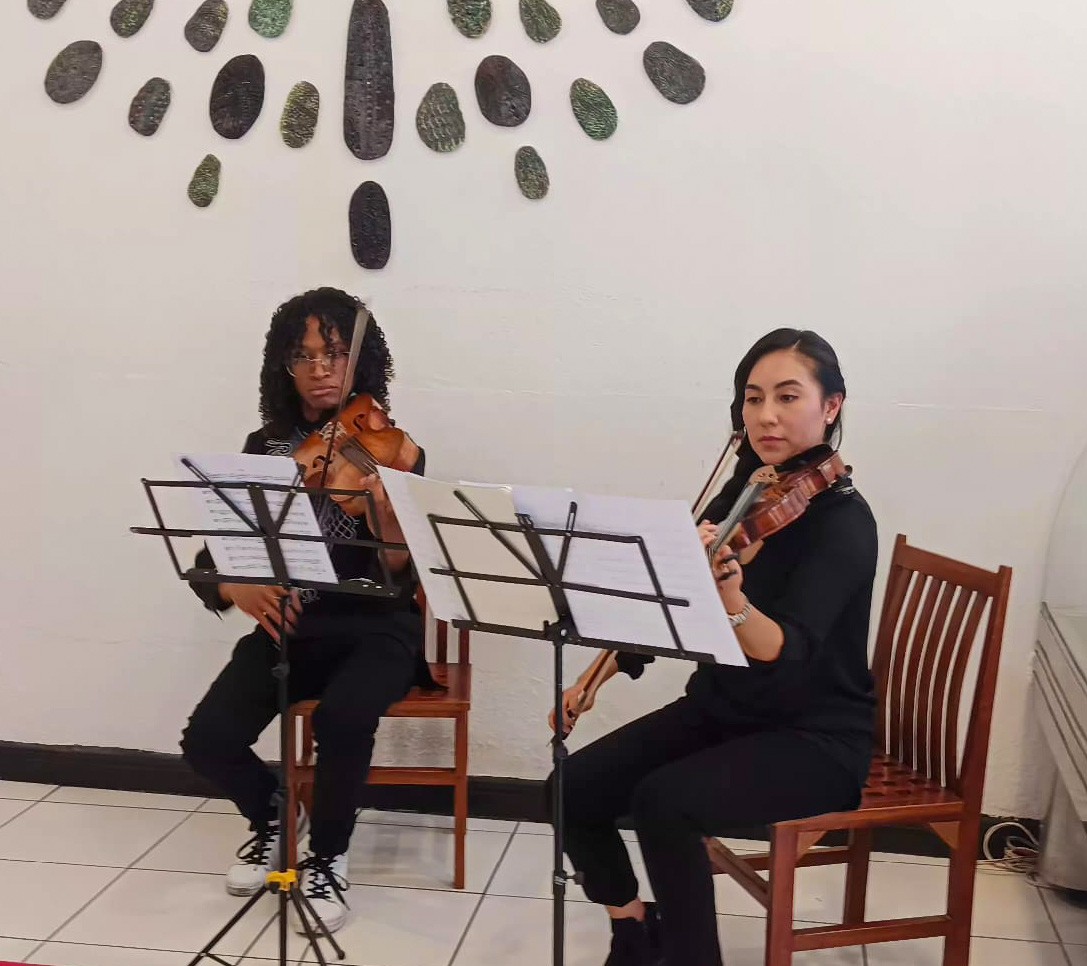
Music on the Menu in Cuenca, Ecuador
New ACMP members played a café concert in Cuenca, Ecuador.Read More ↗
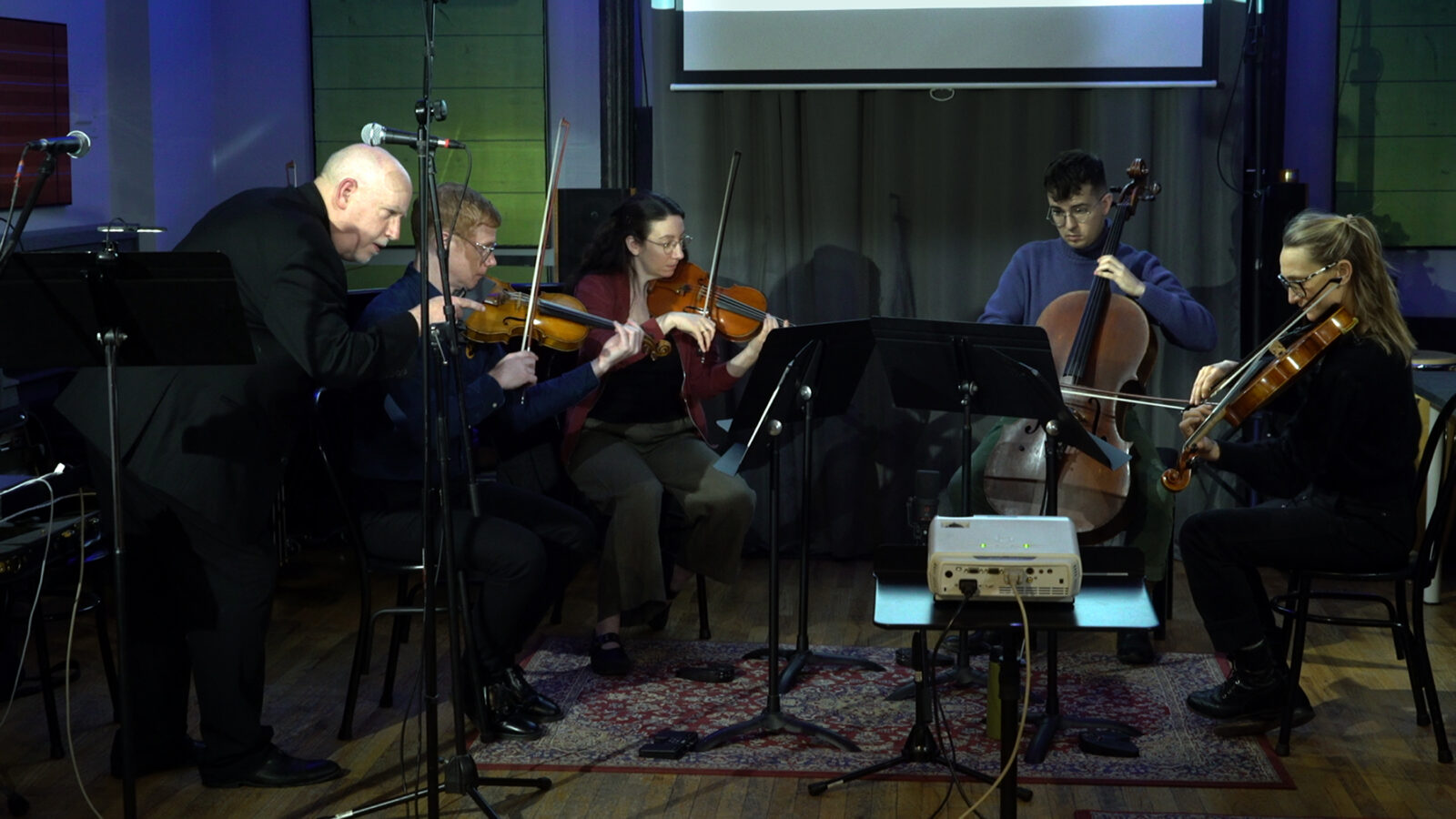
New Video: Turning ink blots into music – a discussion on the meaning and madness of notation
Cal Wiersma and his willing ACMP member partners explored the process of decoding musical notation to begin to answer that eternal question – how do I turn these dots, dashes, squigglies, slurs, round blotches and straight lines into MUSIC? How does one decide what to make of all of this maddeningly imprecise notation? Watch the video of the live-streamed class.Read More ↗
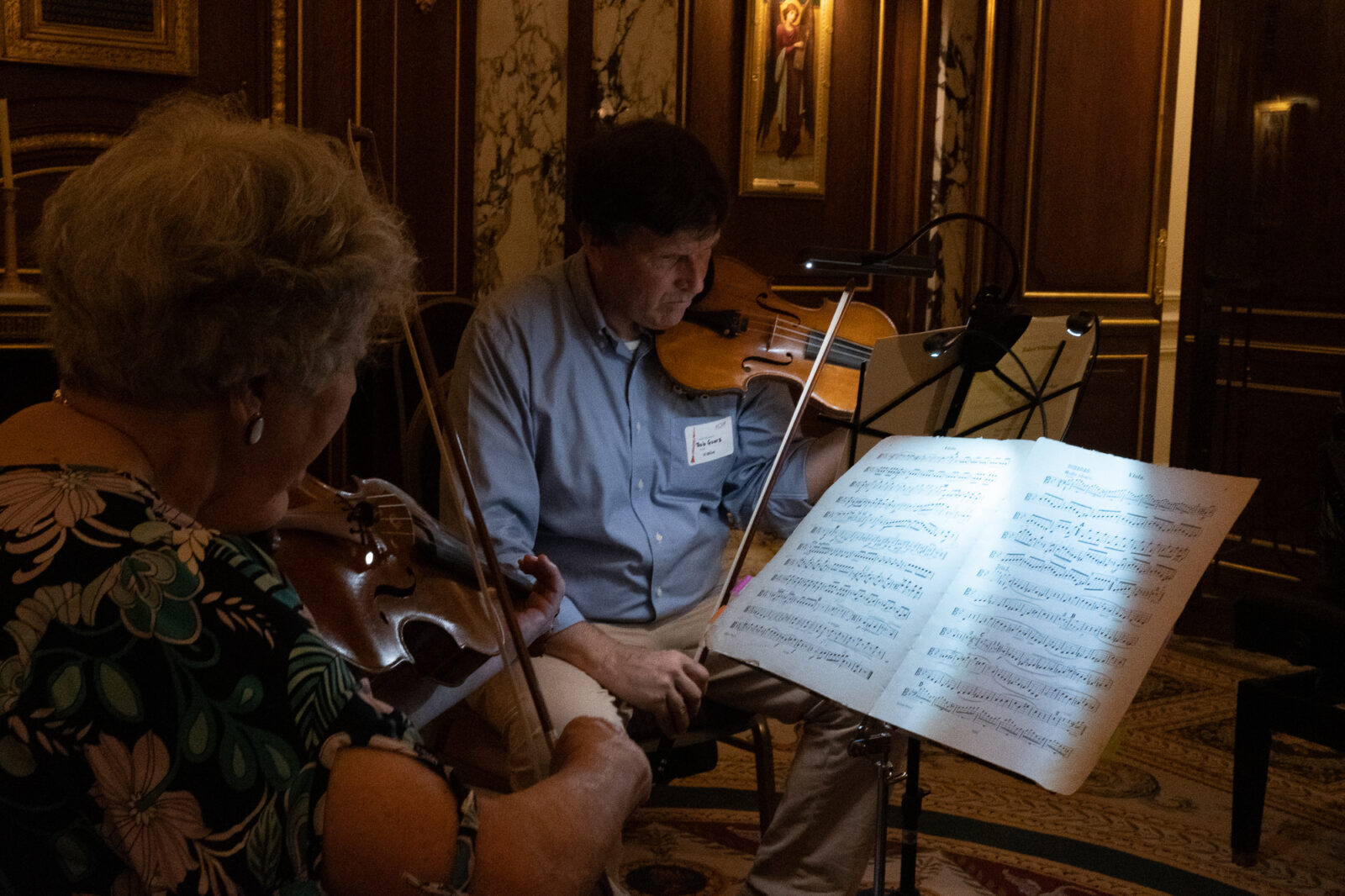
Henry, Gideon, Joan and me
ACMP Board Chair and violinist Bob Goetz reminisces about a deeply moving early experience with ACMP.Read More ↗
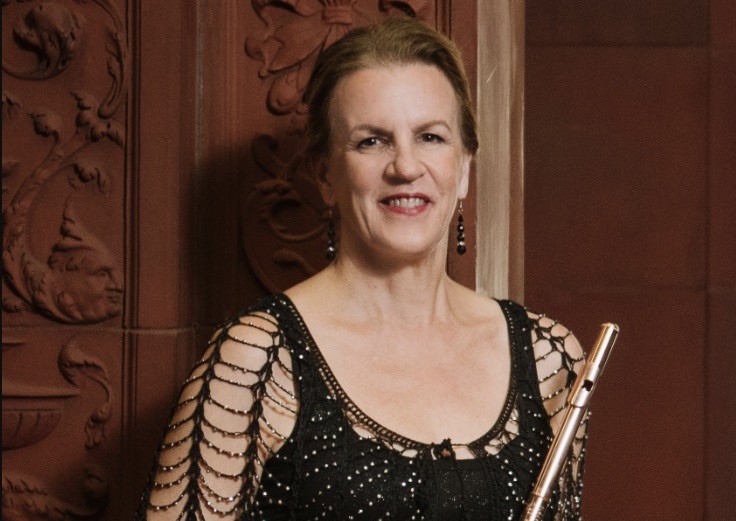
Meet the Musician: Flutist Svjetlana Kabalin (Video)
Watch Stephanie Griffin's interview and Q&A with Svjetlana Kabalin, Artistic Director of the Sylvan Winds, a wind quintet she has led for over 46 years.Read More ↗
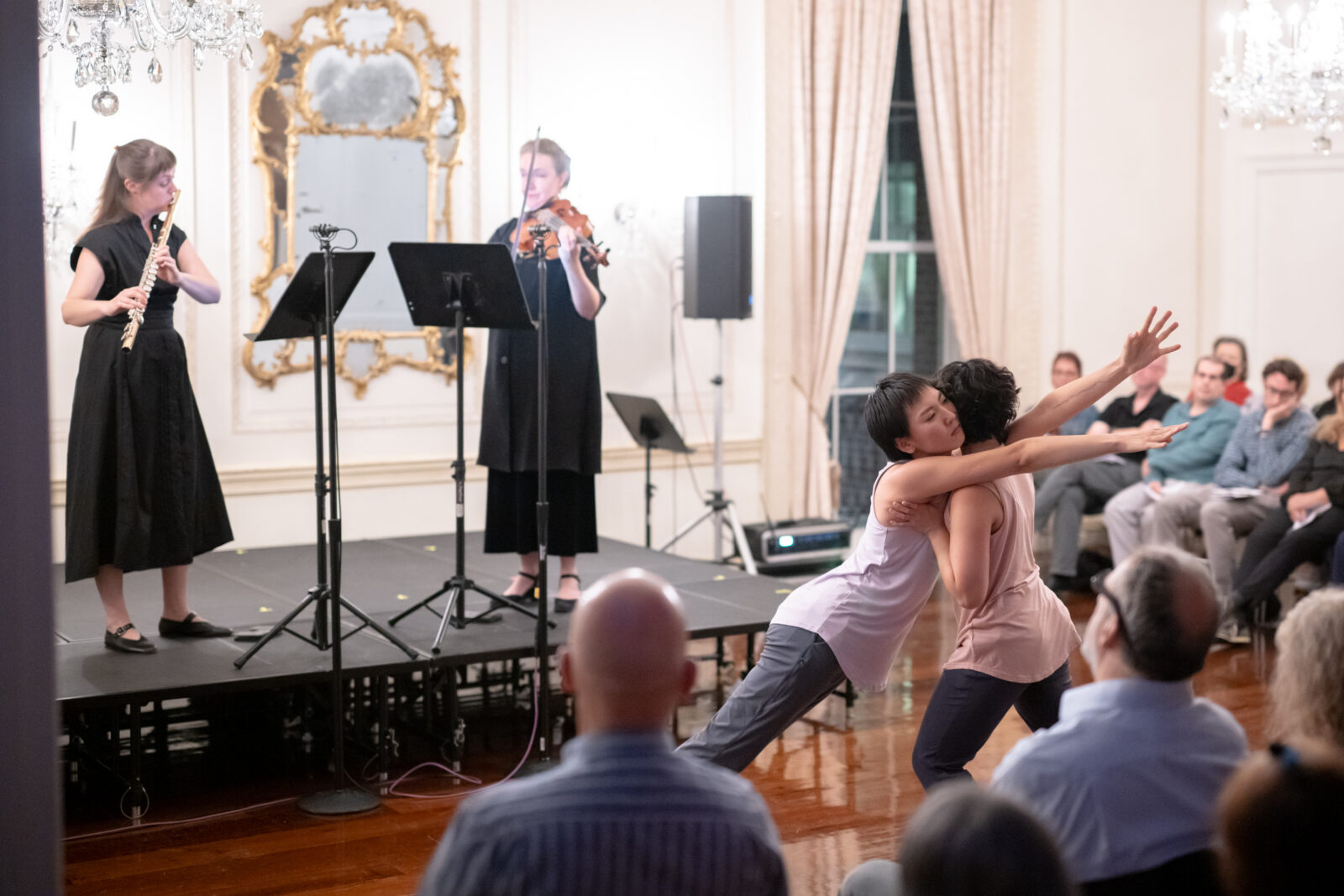
What I learned from wind players
ACMP Executive Director Stephanie Griffin reflects upon her personal experiences working with wind players as a violist and composer. All of us musicians can learn so much by listening to and especially playing with musicians who produce sound in a completely different way than we do!Read More ↗
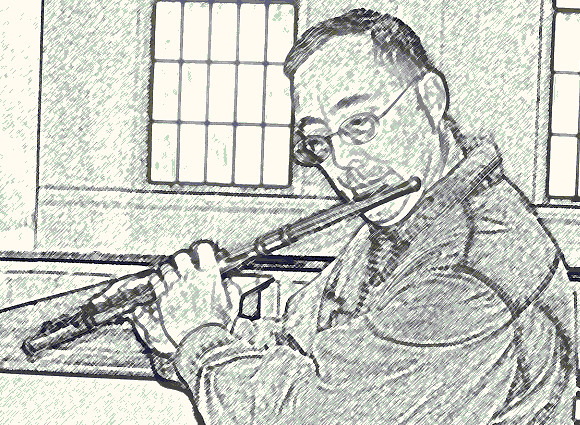
Interview with Joe Wilson and Edward Guo
ACMP member flutist Joseph Wilson has been actively adding to the chamber music repertoire for flute, by making original arrangements and transcribing parts and scores from manuscript, and uploading them to IMSLP. Watch the video of him in conversation with Stephanie Griffin and IMSLP founder Edward Guo.Read More ↗
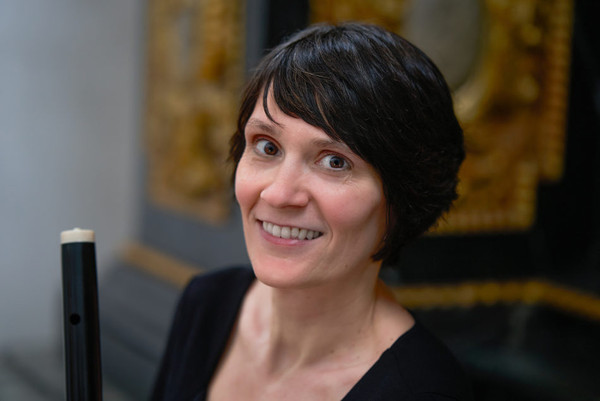
Put a flute on it! Arrangements of Haydn string quartets for flute and string trio
Looking for top-quality repertoire with flute and strings for your ACMP Haydn Challenge gathering? Put a flute on the opus 20 string quartets. Listen to the beautiful recording by the Campanile Ensemble with Hungarian Early Music flutist Ildikó Kertész.Read More ↗

The Flute: Beloved of Amateurs
The flute has been a favorite of avocational musicians in the US since the colonial period. While most players are lost to history, many notable figures have played it, from John Quincy Adams to astronaut Cady Coleman.Read More ↗
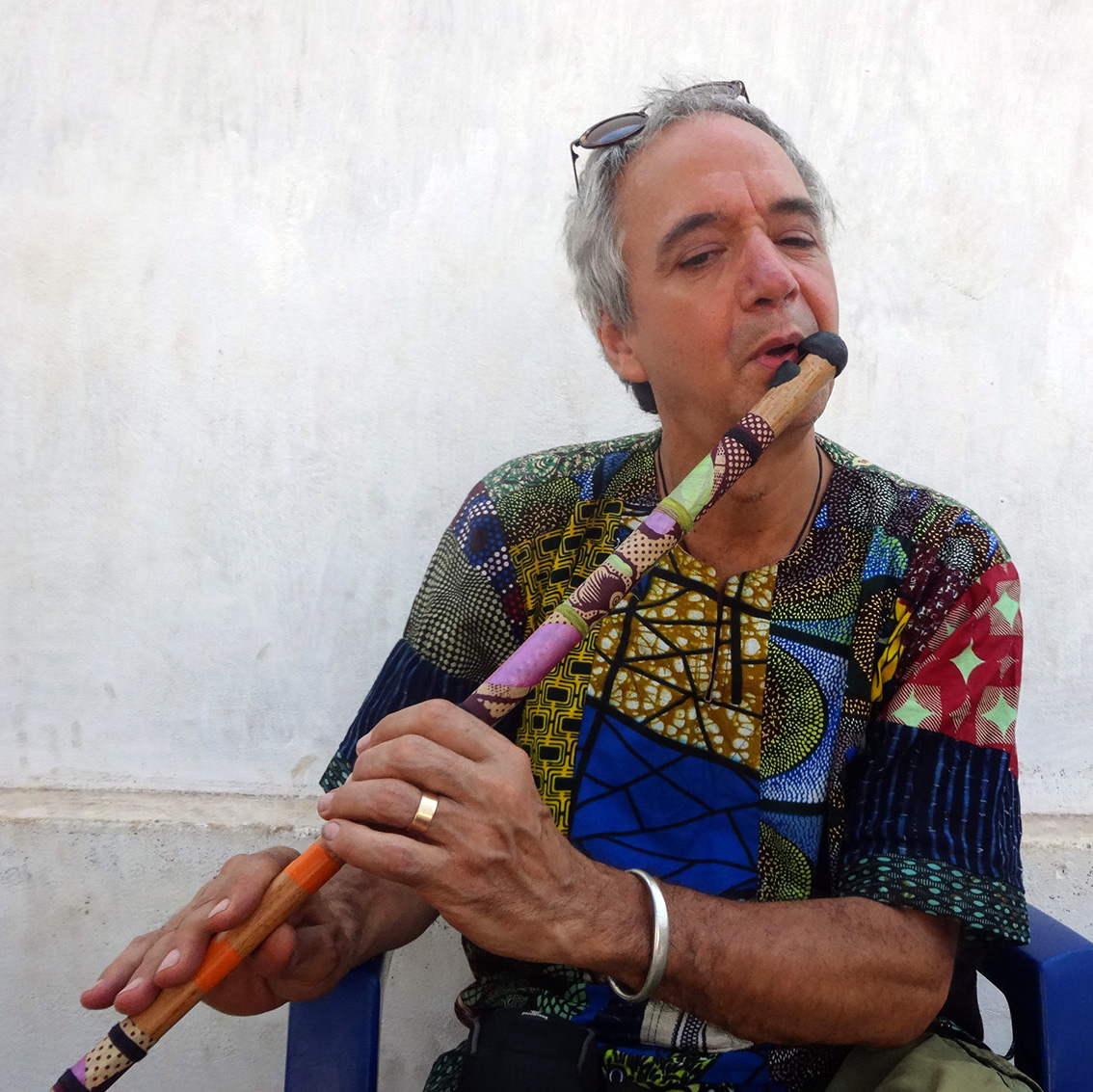
My journey with the Fula flute
Flutist Sylvain Leroux recounts his adventures with the Guinean Fula Flute. He fell in love with the Fula Flute listening to a record in the early 1980s, and his journey led him to performing around the world, inventing new Fula Flutes with extended possibilities, and founding a school in Guinea.Read More ↗
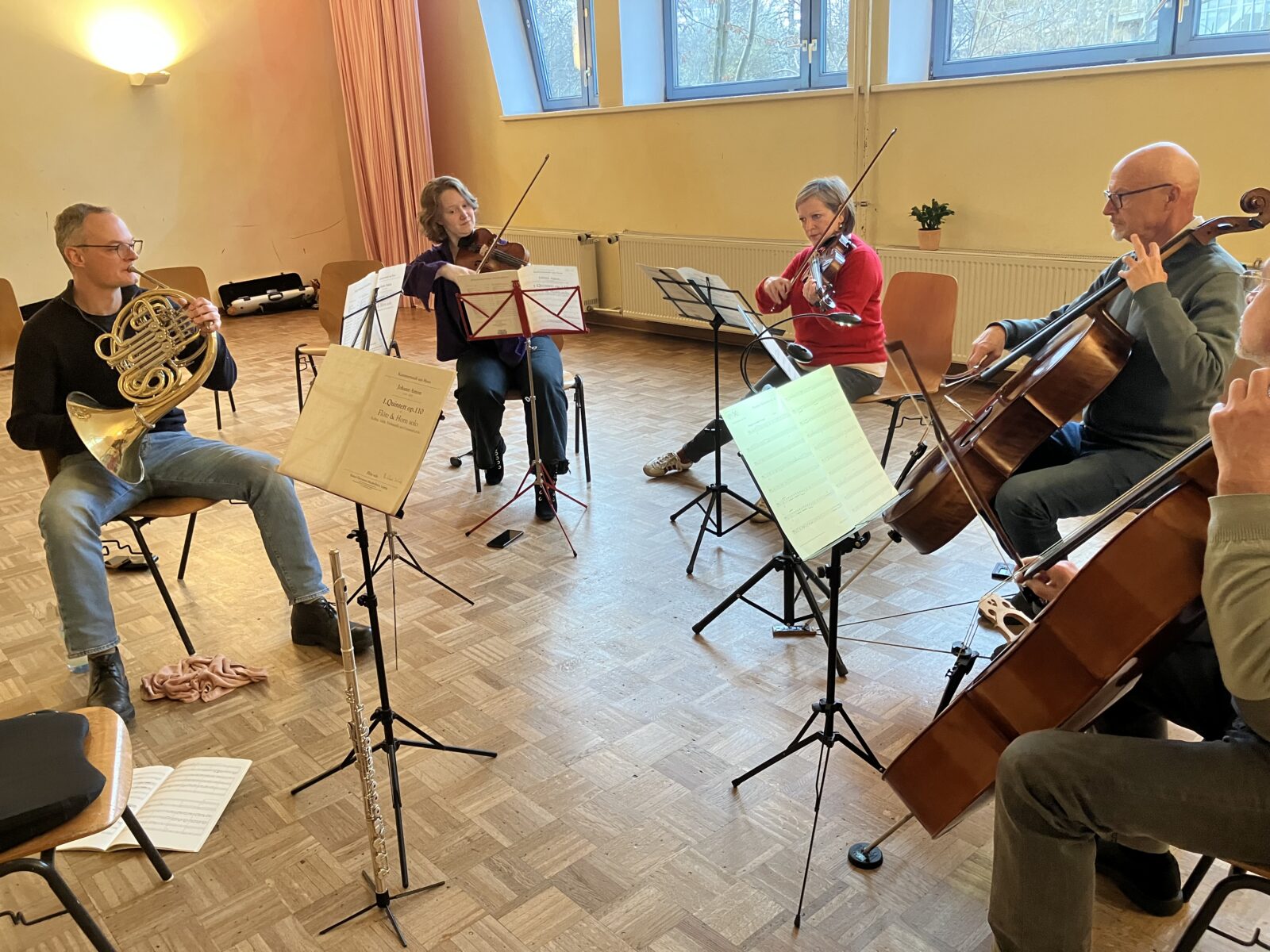
Music for winds, strings and piano at the first Berlin Play-In of 2026
On March 14, 2026 seventeen chamber players gathered at the first Berlin Play-In of the year, made possible in part with the support of ACMP. They played a varied menu of chamber works for flute, oboe, horn, piano and strings.Read More ↗
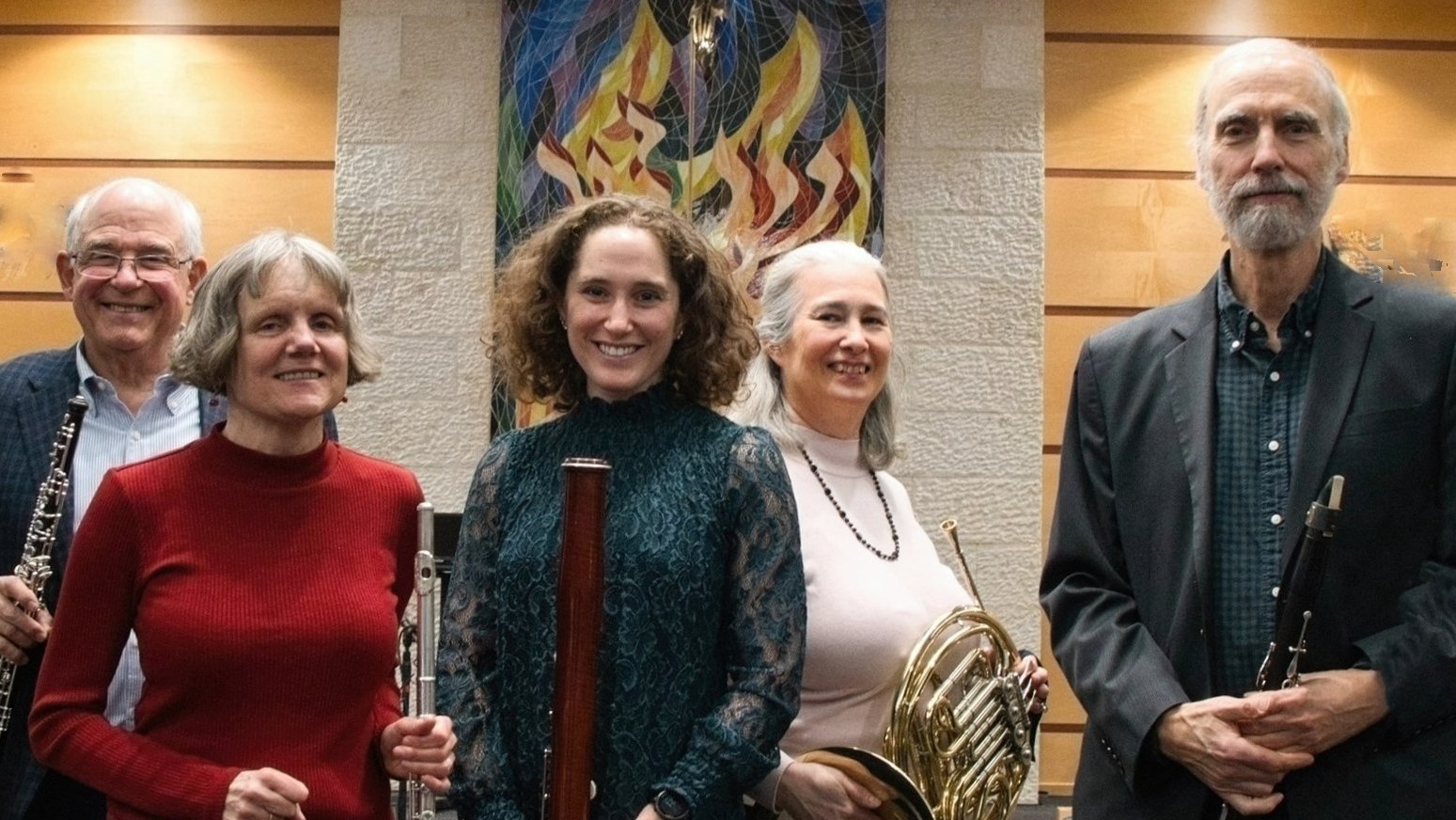
Chamber music, the Horn and Friends
There's more to chamber music with horn than just the standard wind quartets and quintets. Liz Dejean shares her favorite repertoire for horn combined with strings, piano and strings or other other winds, and larger ensembles.Read More ↗
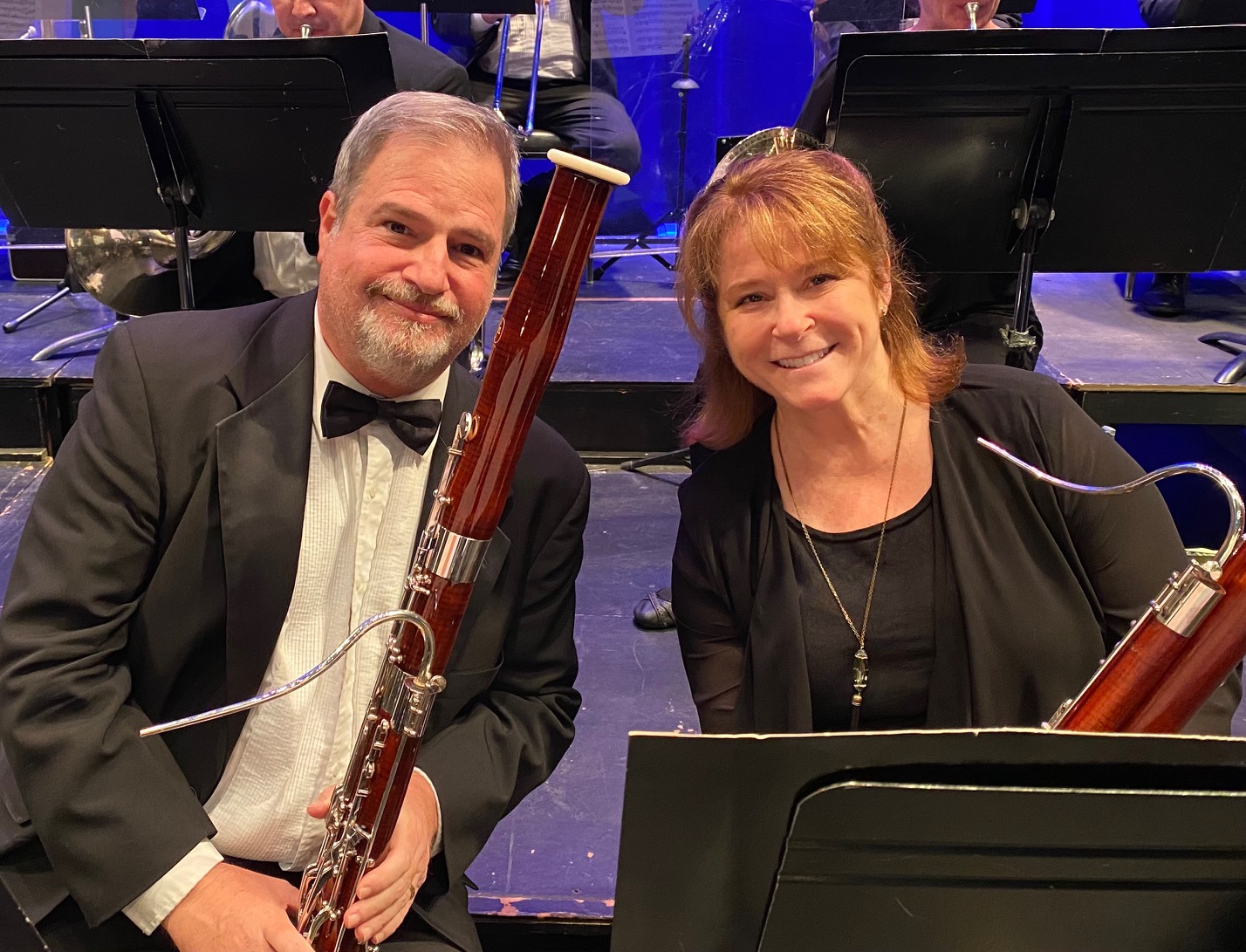
A Visit to Trevco Music
Bassoonist Chris Foss waxes poetic about his recent visit to the Trevco Music headquarters in Middlebury, Connecticut where one can browse the stacks of literally 1800 pounds of music for wind quintet, along with any chamber music you can imagine and lots of fun arrangements involving winds. You can even get a discount with a secret code!Read More ↗
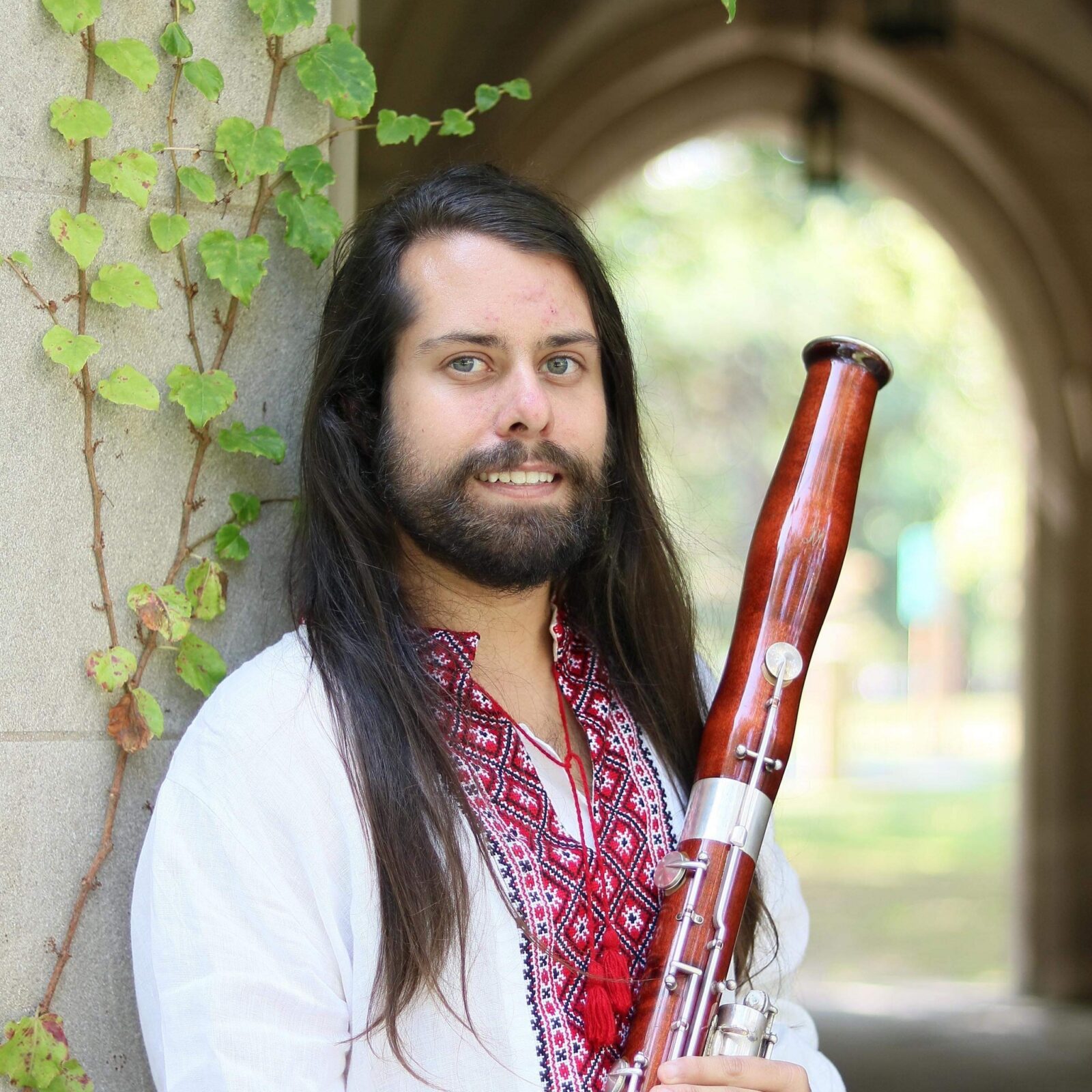
The Ukrainian Chamber Music Encyclopedia: a resource for wind players
Ukrainian Canadian bassoonist Zachary Senick has devoted his research and performance life to unearthing the vast catalogue of chamber music for winds and music for solo bassoon by Ukrainian composers. Explore the Ukrainian Chamber Music Encyclopedia and the offerings made available by Editions Plamondon.Read More ↗
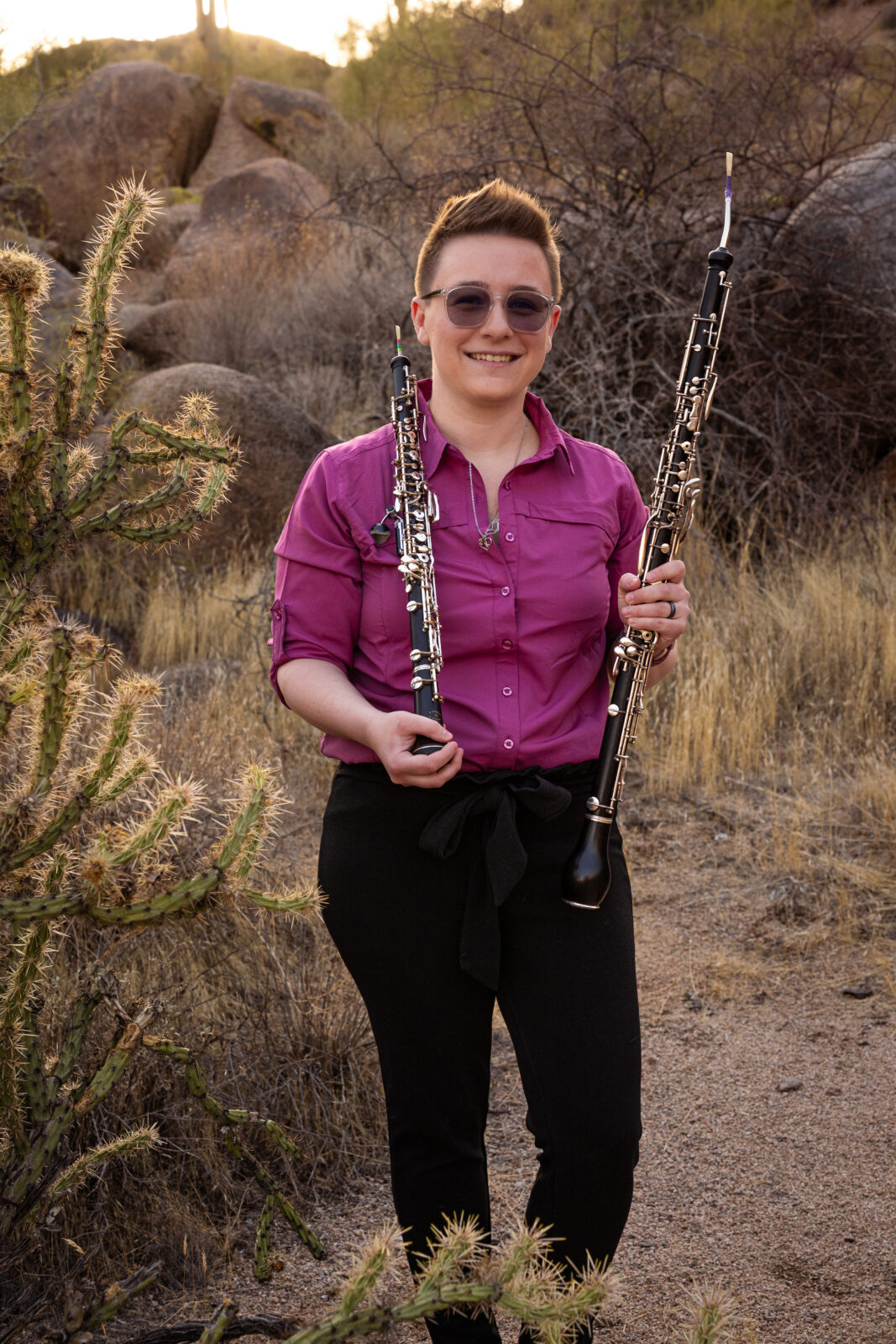
Chamber repertoire for oboe: a curated list
Oboist and scholar Dr. Kelsey Maes has shared her 60-page list of chamber music with oboe with ACMP. The list is organized by country, style and time period and is easy to navigate with hyperlinks in a detailed table of contents. Explore the list and discover new pieces to play with oboe!Read More ↗
Load More
All Articles By